
Trees
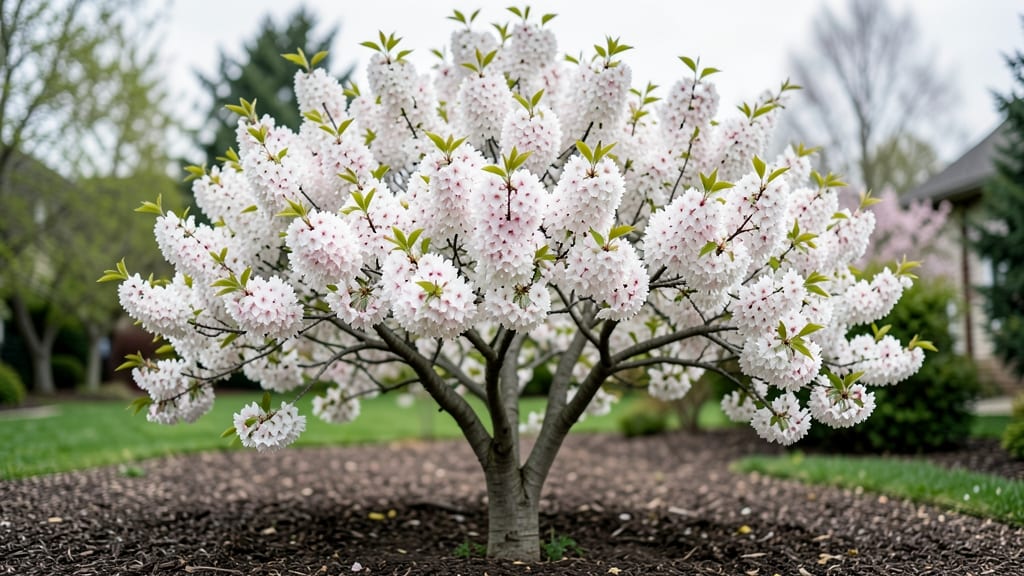
Flowering cherry trees exhibit stunningly different growth rates, depending on the variety, with some varieties shooting up 3 feet per year while others take their time reaching maturity.
Picture this: You plant a sapling in spring, dreaming of pink or white clouds of blossoms by summer. But how fast will your 🌸 Flowering Cherry actually grow?
The answer depends on the type—some burst into bloom in just a few years, while others play the long game, taking a decade to reach their full glory.
Understanding these growth rates helps you plan where to plant, when to expect those first show-stopping flowers, and how to give your tree the best care for faster, healthier growth.
From Yoshino cherries that grow like rockets to Okame varieties that take their time, we’ll break down what to expect each year.
Ready to set realistic timelines and optimize your tree’s growth? Here’s how to track progress, adjust care, and get those blooms sooner than you think.


Flowering cherry tree growth rates by variety: yearly height increase
If you're planning your garden layout around a flowering cherry tree, knowing its yearly growth rate is essential. These trees are stunning additions, but their growth varies widely by variety.
From the fast-growing Kwanzan to the more modest Okame cherry, understanding these differences helps you set realistic expectations for pruning, placement, and bloom anticipation.
Most flowering cherry trees start small but grow rapidly in their early years. For example, a Yoshino cherry might reach 6-10 feet in just two years, while a dwarf variety like Autumnalis grows more slowly, staying under 15 feet at maturity.
This variety-specific growth rate ensures you choose the right tree for your space and timeline.
Below is a summary table comparing popular flowering cherry varieties, their yearly height increases, and mature sizes. Use this as a guide to plan your garden layout and anticipate when your tree will reach its full glory.
The Yoshino cherry is one of the fastest-growing varieties, often reaching 10 feet in just three years. This makes it ideal for gardeners who want to enjoy its stunning spring blooms sooner rather than later.
If you're working with limited space, the Autumnalis cherry is a fantastic choice, as it stays compact and blooms repeatedly throughout the season.
When planning your garden, consider the mature height of each variety. A Kwanzan cherry, for example, can reach 35 feet, so it’s best suited for larger yards or as a focal point in a park-like setting.
Meanwhile, the Okame cherry remains more manageable at 15-20 feet, making it perfect for smaller gardens or urban landscapes.
Understanding these growth rates also helps with pruning and maintenance. Faster-growing varieties like the Yoshino or Kwanzan may need more frequent pruning to shape their growth and remove dead branches.
In contrast, slower-growing varieties like Autumnalis require less aggressive pruning but benefit from regular checks to ensure healthy growth patterns.
Another key factor is bloom
Factors that affect flowering cherry growth rate and how to optimize them
Your flowering cherry tree’s growth rate isn’t just about luck—it’s a mix of science and care. The right conditions can turn a 2-foot sapling into a 15-foot beauty in just 5 years. But get the care wrong, and you’ll see slow, leggy growth with fewer blooms.
Let’s break down the key factors that control your tree’s speed and how to tweak them for faster, healthier growth.
From soil quality to pruning techniques, every detail matters. For example, a Yoshino cherry planted in rich, well-draining soil with full sun can grow 3 feet per year, while the same tree in compacted clay might barely reach 1 foot annually.
The difference? Optimizing conditions—and I’ll show you exactly how.
- 🌞 Sunlight Exposure: 6+ hours of direct sun daily maximizes photosynthesis. Partial shade slows growth by 30-50%.
- 💧 Watering Depth: Deep watering 2-3 times per week in summer encourages root expansion. Shallow watering leads to weak stems.
- 🪴 Soil Type: Well-draining, slightly acidic soil (pH 5.5-6.5) is ideal. Compacted or alkaline soil restricts root growth.
- ✂️ Pruning Timing: Prune in late winter (before buds swell) to remove dead or crossing branches. Avoid heavy pruning in spring—it delays flowering.
- 🌿 Fertilization: Use a balanced 10-10-10 fertilizer in early spring and light feed in summer. Over-fertilizing causes leaf burn and weak blooms.
Let’s start with the foundation: soil quality. Flowering cherries thrive in loamy, well-draining soil with a pH between 5.5 and 6.5. If your soil is heavy clay, amend it with compost and perlite to improve aeration.
I’ve seen slow-growing trees double their growth rate after just one season of soil improvement. Test your soil’s pH with a home test kit—it’s a game-changer.
Next up: sunlight exposure. These trees are sun-worshippers, needing at least 6 hours of direct sunlight daily. Plant them in the south-facing side of your yard for best results.
If you’re in a shady spot, consider a dwarf variety like Okame cherry, which tolerates partial shade better than standard types. Without enough light, your tree will grow tall but leggy with sparse blooms.
Watering is another make-or-break factor. Young trees need deep watering 2-3 times per week during their first year, while established trees thrive on weekly deep soaks. The key? Water at the base of the tree, not the leaves, to prevent fungal diseases.
I’ve noticed that morning watering reduces evaporation and keeps roots happy. Overwatering is just as bad as underwatering—it causes root rot and stunted growth.
Don’t forget seasonal care adjustments! In spring, focus on fertilizing and pruning to kickstart growth. By summer, reduce watering slightly and watch for pests like aphids. In fall, stop fertilizing and let the tree harden off before winter.
I’ve seen trees that bloom twice as heavily the following year after proper fall care. It’s all about preparing for dormancy.
Finally, pruning techniques can accelerate growth or slow it down. Prune in late winter to remove dead wood and crossing branches. Avoid heavy pruning in spring—it delays flowering by 1-2 years.
For faster height gains, focus on structural pruning to encourage upward growth. I’ve helped clients increase their tree’s height by 50% in just two years with the right pruning strategy.